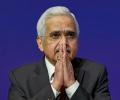
The highlights of RBI's bi-monthly monetary policy announced by Governor Shaktikanta Das:

Expensive food and clothing pushed up the Consumer Price Index (CPI) by 1.18 per cent in August vis-a-vis the previous month, but experts said too much should not be read into the numbers, as the data on retail prices is yet to stabilise.

Guess the price of Rashmika's outfit... Rakul sips on hot chocolate... Yami goes Dhoom Dhaam...

'At least 25 Olympic-sized swimming pools worth of plastic chewing gum gets dumped.' 'And because the way people spit it out, there's no possible way this plastic can be recycled.'

'The risk is in not being invested and missing out on an upmove.'
Retail prices of sugar dipped 6 per cent after the government announced a slew of measures on January 13. Prices of grain and pulses have remained unchanged.

Preparing a 'vegetarian thali' got dearer by 34 per cent in July as compared to June because of the soaring tomato prices, an arm of a rating agency said in a report on Monday. A non-vegetarian thali was relatively less impacted and the price of preparing one went up by only 13 per cent, Crisil's 'Roti Rice Rate' report for August said. The inflation in the thalis is largely driven by the 233 per cent jump in tomato prices to Rs 110 per kilogramme in July from Rs 33 in June, the report said.
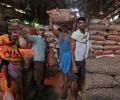
Snapping its declining trend, retail inflation rose to a three-month high of 5.55 per cent in November on firming food prices, including vegetables and cereals, though it remains within the RBI's comfort zone of less than 6 per cent. Inflation based on the Consumer Price Index (CPI) was 4.87 per cent in October and 5.88 per cent in November 2022, the government data released on Tuesday showed. The previous high was 6.83 per cent in August and inflation had been on a decline since then.
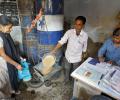
The free food scheme is driven by electoral considerations, but its long-term fiscal risks outweigh the short-term gains, cautions A K Bhattacharya.

"These latest so-called 'Liberation Day' tariffs are reckless and self-destructive, inflicting financial pain on Illinois at a time when people are already struggling to keep their small businesses afloat and put food on the table."
"It also, however, increases demand. So, for example, just as an interesting thought for you, there are 350 million people in India who are classified as middle class. That's bigger than America. Their middle class is larger than our entire population." "And when you start getting wealth, you start demanding better nutrition and better food, and so demand is high, and that causes the price to go up," Bush said.

Moody's Ratings on Tuesday said India's growing water shortage can disrupt farm and industry sectors and is detrimental to the credit health of the sovereign as rising food inflation and decline in income may spark social unrest. It said decreases in water supply can disrupt agricultural production and industrial operations, resulting in inflation in food prices and hence can be detrimental to credit health of sectors that heavily consume water, such as coal power generators and steel-makers.
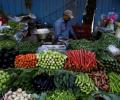
Inflation in food articles during May stood at 1.13 per cent, as against 2.55 per cent in April.
Food inflation continues to run amok, and very clearly, the government does not seem to have any clue on how to rein it in.
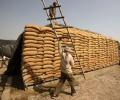
The fall in global prices resulted in a drastic decline in the Food Price Index compiled by the United Nations' Food and Agricultural Organization. Based on the prices of a basket of internationally traded food commodities, the FAO Food Price Index averaged at 203.9 points in July, down 4.4 per cent (2.1 percentage point) from a revised value in June. This level was seen earlier in January, at 203.2 points.

Following widespread drought and floods in various parts of the country, food inflation climbed to more than a 10-year high of 19.95 per cent in December, driven mainly by higher prices of potato, other vegetables and pulses.

India's extreme poverty rate declined sharply to 5.3 per cent over a decade from 27.1 per cent in 2011-12 even as the World Bank revised upwards its threshold poverty line to $3 per day.

India maintains "high" import duties on a wide range of American goods such as agricultural items, drug formulations, and alcoholic beverages, besides imposing non-tariif barriers, a US report has said. A day before announcing reciprocal tariffs, the US Trade Representative (USTR) released the 2025 National Trade Estimate (NTE) Report on March 31.
G20 needs to leverage its clout to play a more proactive role in stabilising food and fuel prices.
After years of high food prices, India is now witnessing a deflation, according to the government's food inflation data.

The USTR report, released just ahead of the US' April 2 deadline for implementing reciprocal tariffs, has also cited high tariffs and price caps, which have not increased in line with inflation, as key obstacles for US businesses.

Oil and LNG prices are likely to shoot up if Iran is to block Strait of Hormuz, through which countries like India import crude oil from Saudi Arabia, Iraq and UAE, leading to a spike in inflation, analysts said on the Iran-Israel conflict. The Iran and Israel conflict has escalated over the last few days. Iran first launched drone and rocket attacks on Israel, which retaliated by firing a missile. Crude oil prices have hovered around USD 90 per barrel since the conflict.
Inflation rose to 4.86 per cent in June, driven mainly by rising prices of food articles, especially vegetables including onion.
Snapping the five week rising trend, food inflation softened to 16.91 per cent for the week ended January 1, 2011.
Week on week, food inflation climbed 0.36 percentage points from 15.10 per cent on September 4.

This was the fifth consecutive week in which the rate of food prices has risen, after a spell of moderation in July and the first half of August.
This would signal the third straight month of contraction.

Marico may buck the industry trend with the fast-moving consumer goods (FMCG) major reporting strong growth and favourable commentary in a weak quarter for the industry. The company reported consolidated revenue growth of 8 per cent year-on-year (Y-o-Y) in Q2FY25. Domestic revenue growth was 8 per cent Y-o-Y with 5 per cent volume growth (4 per cent in Q1FY25).
After facing sharp rise in prices of most food items in 2008, consumers can look forward to a relatively comfortable situation this year in commodities like wheat, rice and edible oil. However, sugar prices, which have remained depressed for the last two years, are likely to move up.

Frankly, I never expected to be offroading in an electric vehicle, let alone an SUV of this calibre, raves Rajesh Karkera/Rediff after a test drive.
There remains a debate on who said this: "When the facts change, I change my mind. What do you do, Sir?" Was it the British economist John Maynard Keynes or the American economist Paul Samuelson. Irrespective of who said it, this sentiment appears to have found resonance in ITC's boardroom in recent years.

'A possible post-election growth momentum may be lost.'
Finance Minister Pranab Mukherjee expressed hope that food prices will fall further after the festive season, even as he expressed concern over the high prices of non-food and fuel products.
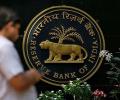
The RBI on Wednesday slashed key interest rate by 25 basis points, for the second time in a row, to support a shuttering economy hit by reciprocal tariffs imposed by the US. Following the rate cut, the key policy rate eased to 6 per cent providing relief to home, auto and corporate loan borrowers.
India's fast-moving consumer goods (FMCG) sector grew 5.7 per cent by value and 4.1 per cent by volume in the July-September quarter driven by rural demand, consumer intelligence firm NielsenIQ said in its quarterly update on Thursday. Price-led growth stood at 1.5 per cent. According to NielsenIQ data, rural volume growth outpaced urban markets for the third straight quarter despite consumption softening in both regions.
Agriculture Minister Radha Mohan Singh said whenever BJP came to power, prices of essential commodities saw a fall.
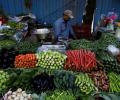
Unprecedented rains and floods in the northern region in the past few days have not only caused extensive damage to lives and property but have also impacted business and commercial establishments. Vegetable prices have gone through the roof in the national capital and many other parts of the country since rains started pouring earlier this month. Traders say vegetable prices would come down only after roads open and skies clear, even as water in the fields will take time to recede.
The Central government hiked the minimum export price of non-Basmati rice from $650 to $ 1,000. As the govt struggles to rein in the rising inflation rates, it is clear that the farm loan waiver in the Budget is not a permanent solution. The cost of growing food is increasing each day and this will continue to push farmers to take loans to survive. To check inflation the govt will have to continue to control food prices. The move to waive farmer loans then seems meaningless.
Very sensitive items -- such as apples, which carry political weight and are closely tied to farmer interests in states like Himachal Pradesh and Uttarakhand -- may face restricted concessions.

Food delivery and quick-commerce major Swiggy, which is coming out with its initial public offering (IPO) on Wednesday, is seeking a valuation of about $11.3 billion. The Bengaluru-based company is aiming to garner Rs 11,327 crore from the IPO, which will comprise a fresh issue of shares worth Rs 4,499 crore along with an offer for sale (OFS) of Rs 6,828 crore. Swiggy has set a price band of Rs 371 to Rs 390 per share for its maiden public issue.
